
TL;DR: Choosing a behavioral health billing company is about more than finding someone to submit claims.
You need a partner who understands VOB, prior authorizations, utilization review, denial follow-up, patient billing, reporting, and the unique payer rules tied to detox, residential, PHP, IOP, and outpatient care.
At Aspen Ridge Medical, we help you protect the entire payment path.
With the right billing partner, you can reduce avoidable denials, improve visibility, protect cash flow, and give your team more time to focus on patient care.
Your last billing company may have promised that things would get easier. The onboarding felt organized, the reports looked professional, and the process sounded solid.
But a few months later, you were still chasing answers about denied claims, missed authorizations, and delayed payments.
If that feels familiar, you’re not the only provider who has been there. Behavioral health billing is different from general medical billing, especially for detox, residential treatment, PHP, IOP, and outpatient care.
This article will help you understand how to choose a behavioral health billing company by explaining what matters during the evaluation process and what separates partners who protect your revenue from companies that simply process claims.
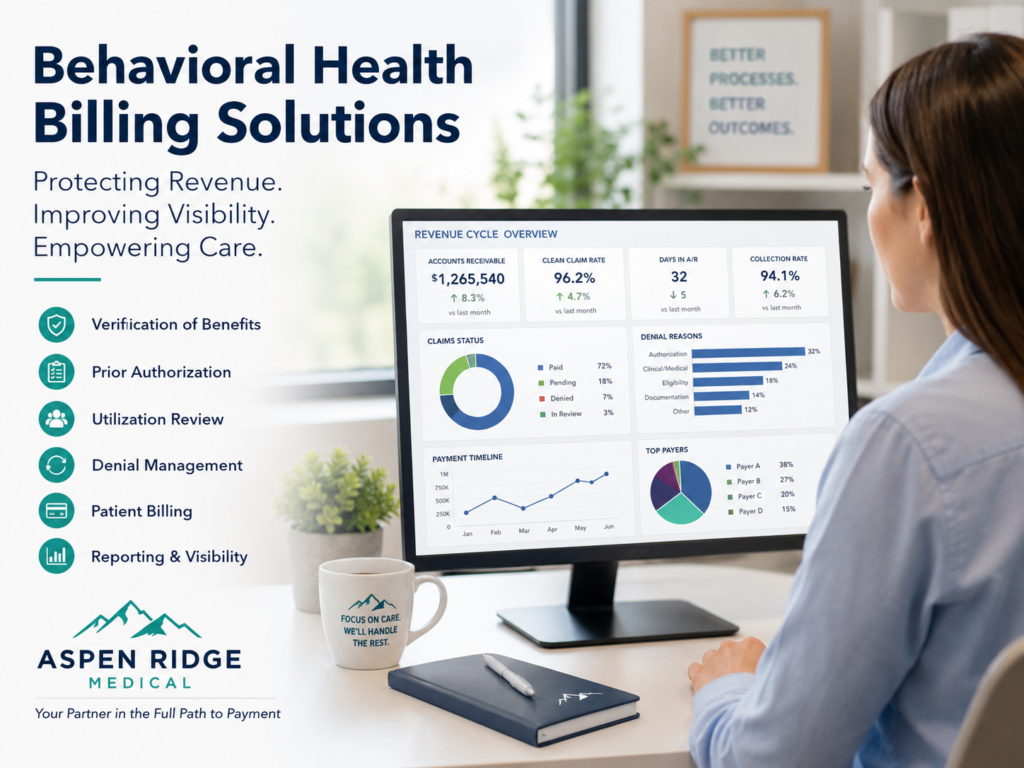
What the Full Path to Payment Looks Like
Before you decide which behavioral health billing company to choose, it helps to understand what a strong path to payment should include.
Protecting revenue means watching every step that affects whether you get paid, how quickly you get paid, and how much you collect.
For most behavioral health providers, that path includes:
- Verification of Benefits (VOB): Before a patient is admitted, your team needs to confirm what their insurance covers, the deductible, whether prior authorization is required, and any exclusions.
- A missed detail here can lead to serious revenue loss later. This is why working with a team experienced in verification of benefits matters.
- Prior Authorization and Utilization Review: Many payers require approval before treatment begins, along with ongoing reviews to continue coverage.
- If your billing partner isn’t tracking these dates and communicating with your clinical team, authorized days may go unaccounted for before anyone realizes there’s a problem. Strong support for utilization management helps keep this process on track.
- Claim Submission: This is the part most people think of as billing. But claims are only as strong as the documentation, coding, and timing behind them. A clean claim starts long before it is submitted.
- Denial Management: Denials can happen, even with a strong process. What matters is whether your billing partner tracks them, appeals them promptly, and looks for patterns to prevent the same issue from happening again.
- Patient Billing and Collections: After insurance pays its portion, there may still be a patient balance. Clear communication and accurate statements help protect revenue while preserving trust with patients and families.
- Reporting and Visibility: You need to see what’s happening across the revenue cycle. Strong reports should help you understand accounts receivable (AR), denial trends, payer issues, payment delays, and where revenue may be getting stuck.
Each step matters. If a billing company only handles one or two parts of the process, the rest of your revenue cycle may still be exposed.
How to Choose a Behavioral Health Billing Company That Fits
Once you know what a strong revenue cycle should include, the next step is finding a billing partner that can support it.
Start With Specialization
Ask how much of their work is focused on behavioral health specifically. Not general healthcare. Not medical billing overall. Behavioral health.
This matters because detox, residential treatment, PHP, IOP, and outpatient care all come with unique payer rules, authorization needs, and documentation standards. A company that mainly works with primary care or general medical practices may not be prepared for the complexity of behavioral health reimbursement.
Look for a partner with direct experience in your level of care. You don’t want your facility to be their learning curve.
Review Their VOB and Authorization Process
Ask how they handle verification of benefits. Do they rely only on automated portals, or do they contact payers directly when needed? How do they confirm details when the portal and payer representative give different answers?
Then ask how they manage authorizations and utilization review. Do they track review dates? Do they communicate with your clinical team before deadlines? Do they follow up when a payer is slow to respond?
Ask About Denial Follow-Up
Most billing companies will say they handle denials. You need to know what that means.
Ask how quickly they review denied claims, how they track denial patterns, and whether they handle appeals in-house. You can also ask what types of denials they commonly recover and how they use denial data to prevent similar issues from recurring.
Look at Their Reporting
Good reports make your revenue cycle easier to understand. Ask to see a sample report before you sign.
Your reports should answer practical questions, such as how much revenue is still outstanding, how long claims are taking to pay, where claims are getting stuck, and which payers are causing the most delays.
If the reports are hard to read or only show surface-level numbers, they may not give you the visibility you need to make better decisions.
Ask About Transition Support
Switching billing companies can feel stressful, but a strong partner should have a clear onboarding process.
Ask how they handle open claims from your previous biller, what information they need from your systems, who will guide the transition, and how they protect cash flow while everything moves over.
A company that takes onboarding seriously is more likely to support you well after the contract is signed.
Confirm Your Main Point of Contact
Clear communication matters more than many providers realize. Before you sign, ask who your main contact will be and how your questions will be handled.
Will you have a dedicated account manager who knows your facility, or will you be routed through a general support queue?
When a claim is stuck, an authorization is close to expiring, or a payer issue needs attention, you need someone who understands your account and can respond quickly.
Find a Billing Partner That Fits the Way You Work
When your billing partner knows how to manage VOB, authorizations, utilization review, claims, denials, reporting, and patient billing together, your team can spend less time chasing answers and more time focused on care.
At Aspen Ridge Medical, we work with behavioral health providers who want practical support, steady communication, and a clearer revenue cycle.
We invite you to start a conversation with our team if you’re reviewing billing options or wondering whether your current setup is still serving your facility.
Frequently Asked Questions
What is the difference between a billing company and a behavioral health RCM vendor?
A billing company often focuses on claims and payment posting. A behavioral health RCM vendor supports the full revenue cycle, including VOB, utilization review, denials, patient billing, and reporting.
How long does it take to transition to a new billing company?
Most transitions take 30 to 90 days, depending on your systems and open claims. A strong partner should give you a clear timeline and help protect cash flow during the change.
Should I look for a company that only works with behavioral health?
Yes, specialization matters. Behavioral health billing has unique payer rules, documentation needs, and authorization timelines that general medical billing companies may not fully understand.
What should I expect from billing reports?
You should expect clear reports that show AR, denial trends, payer delays, payment timing, and overall revenue cycle health. Good reports help you make decisions rather than create more confusion.
Work With a Behavioral Health Billing Partner That Supports the Whole Process
Choosing a behavioral health billing company affects more than your back office. It can impact cash flow, staff workload, reporting visibility, and the time your team has for patient care.
The right partner should support the full payment path, from benefits verification and authorization to claims, denials, patient billing, reporting, and final resolution.
At Aspen Ridge Medical, we help behavioral health providers with verification of benefits, prior authorizations, utilization management, insurance billing, patient billing, reports, and consulting services.
With clear communication and a consistent point of contact, we help your team spend less time chasing claims and more time focused on care.
To learn more, explore how we work, or schedule a billing partner review.
Disclaimer: The content provided by Aspen Ridge Medical is intended for informational purposes only and does not constitute legal, financial, or medical advice. While we strive to ensure the accuracy and reliability of the information, Aspen Ridge Medical does not guarantee its completeness, timeliness, or applicability to specific circumstances. Users should consult qualified professionals directly for specific concerns.


